Example — Human Context Interpreter Sublayer
This page shows one possible way to compose two Human Context Interpreter patterns:
Tiered Semantic Cache / Proxy (TSC/TSP)
Adaptive Signature Learner (ASL)
The example is not a required architecture.
It illustrates how a verbal interpretation pattern and a visual temporal-learning pattern can work together over the same HIF stream.
In this example, a person waves with the right hand and says:
learn this gesture as "hello"
The Text Interpreter TSP interprets the utterance as a bounded semantic instruction.
The Visual Gesture ASL uses that instruction to learn the recent visual motion signature under the name hello.
Example Composition
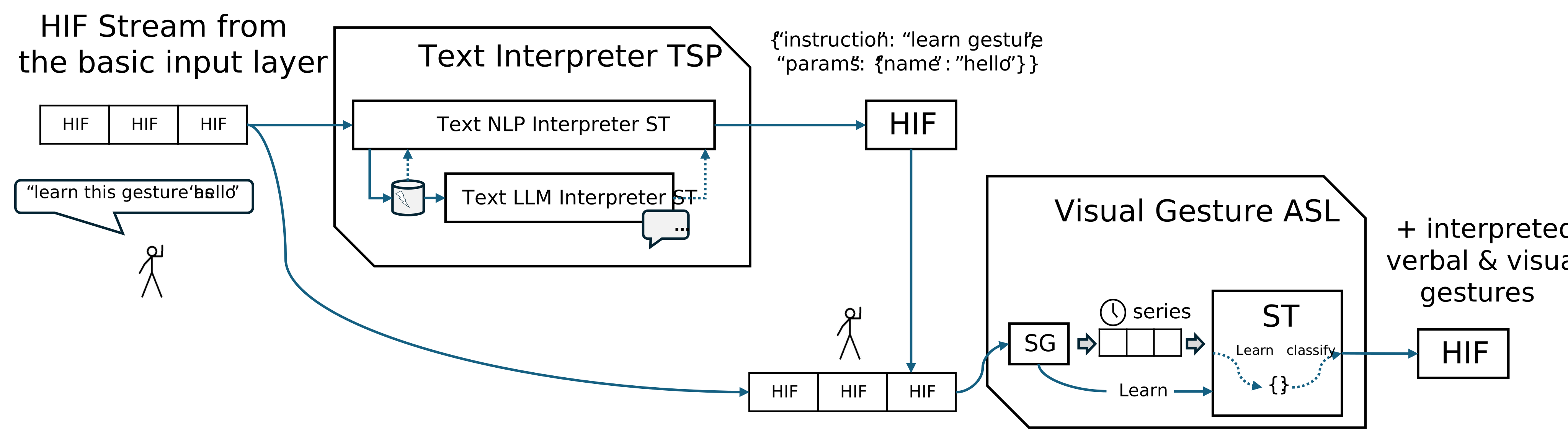
Walkthrough
The HIF stream arriving from the basic input layer contains both visual and verbal evidence.
In this example, the basic layer has already produced a stream that may include:
tracked person
skeleton motion
spoken text
speaker / person association
timing metadata
The person waves and says:
learn this gesture as "hello"
The interpreter sublayer uses two patterns together.
Step 1 — Text Interpreter TSP interprets the verbal instruction
The text portion of the HIF stream is routed to the Text Interpreter TSP.
The TSP may first try a deterministic NLP interpreter.
If the phrase is not directly matched, it may check a semantic cache or escalate to an LLM interpreter constrained to a closed set of supported instruction templates.
The output is a normalized HIF such as:
{
  "instruction": "learn_gesture",
  "params": {
    "name": "hello"
  }
}
This means that the language interpreter does not freely decide what the robot should do.
It maps the utterance into a supported instruction schema.
Step 2 — Visual Gesture ASL receives the learning instruction
The interpreted instruction HIF is routed to the Visual Gesture ASL.
At the same time, the visual HIF stream provides the recent skeleton sequence.
The ASL now has both:
what to do:
  learn a gesture named "hello"

what to learn from:
  the recent visual time-series window
The SG inside the ASL groups recent skeleton HIFs into a coherent time-series window.
The ST then enters learn mode and stores the observed motion signature under the label:
hello
Step 3 — Future classification
After learning, future time-series windows can be compared against the stored signature dictionary.
If a similar right-hand gesture appears later, the ASL may emit a HIF such as:
{
  "type": "GestureHIF",
  "properties": {
    "gesture": "hello",
    "matched_signature": "sig_hello_01",
    "source_window": "recent_skeleton_window"
  },
  "confidence": {
    "match_confidence": 0.87
  }
}
The resulting HIF now contains an interpreted visual gesture that was taught through an interpreted verbal instruction.
Why This Composition Matters
This example shows why the Human Context Interpreter is not merely a text interpreter and not merely a visual classifier.
It binds together:
verbal interpretation
+
visual temporal signature learning
The Text Interpreter TSP gives the system a bounded symbolic instruction:
learn gesture, name = hello
The Visual Gesture ASL uses that instruction to decide how to interpret the recent embodied evidence.
This creates a clean separation:
| Responsibility | Pattern |
|---|---|
| Interpret the spoken instruction | TSC/TSP |
| Build a recent visual time-series window | SG inside ASL |
| Learn or classify the motion signature | ASL |
| Store the learned association | Signature dictionary |
| Emit a structured gesture HIF | ASL output |
Design Note
This is only one possible composition.
The same design idea can support other cases:
"remember this whistle as call me"
"this motion means stop"
"when I do this, follow me"
"this melody means dinner time"
The verbal pattern tells the system what semantic association to create.
The temporal ASL pattern determines what recent signal should be stored or classified.
The learned association may be:
- temporary
- session-local
- user-specific
- robot-specific
- persistent
- operator-approved
- globally shared
A deployment should decide which users are allowed to teach new signatures, which labels are safe, and whether learned signatures can trigger behavior directly or only add semantic annotations.
Resulting Interaction Meaning
Before the interpreter layer, the system may only know:
person moved hand
person said a sentence
After this composition, the system can know:
the sentence was an instruction to learn a gesture
the recent hand motion is now labeled "hello"
future similar motions can be classified as "hello"
This is a small but important step toward interactive, personalized, and explainable human-context learning.