Example — Basic Input Sublayer in the Human Context
This page shows one possible way to compose the first two Human Context patterns into a basic input sublayer.
It is not a required architecture.
It is an illustrative composition showing how raw sensor streams may become a unified semantic interaction frame.
The example is based on three parallel input rails:
camera      → visual human evidence
microphone  → spoken and affective evidence
LiDAR       → spatial footprint evidence
These streams are converted into HIFs, synchronized, grounded in 3D with respect to the map, tracked over time, and emitted as a richer interaction frame.
Example Composition
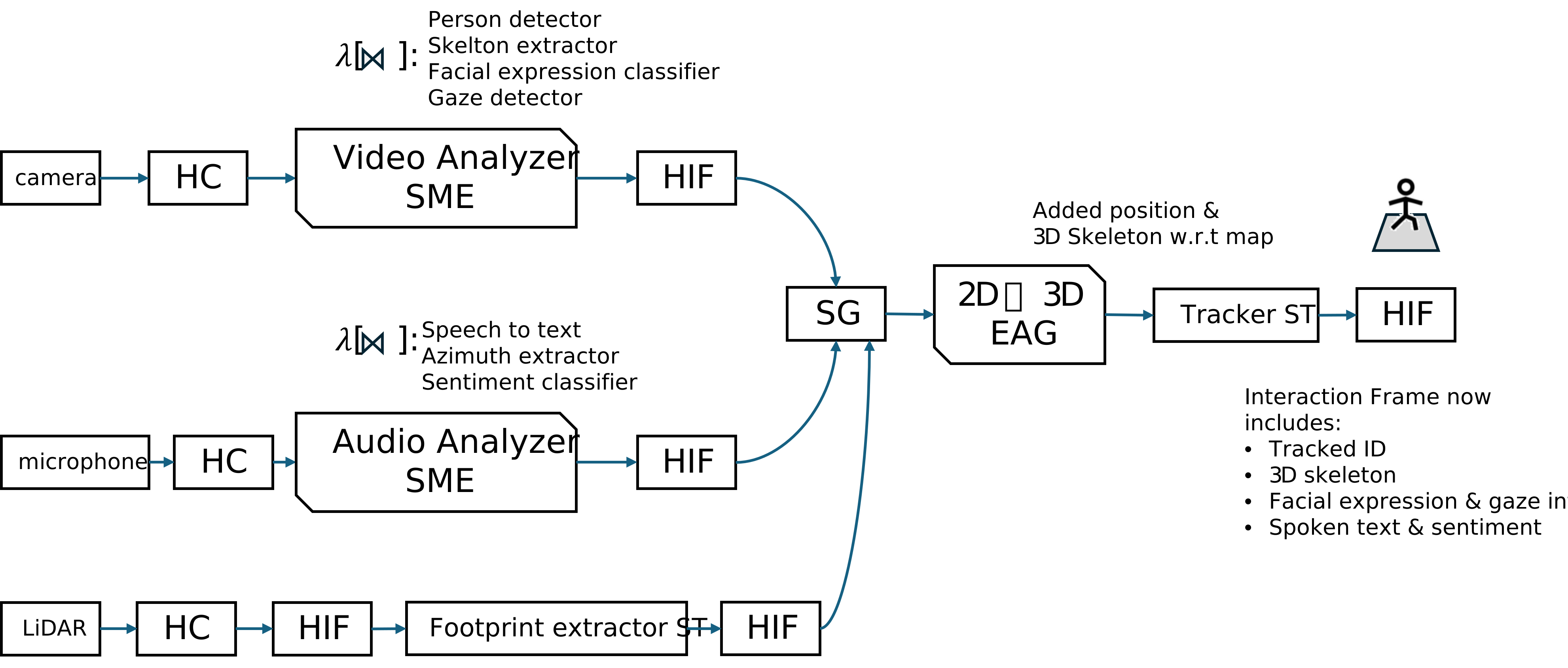
What the Diagram Shows
The diagram illustrates how a basic Human Context input layer may be assembled from reusable HML patterns.
Visual rail
camera → HC → Video Analyzer SME → HIF
The video analyzer is modeled as an SME because several visual experts operate over the same video input:
Person detector
Skeleton extractor
Facial expression classifier
Gaze detector
The result is a visual HIF that contains synchronized evidence about the person as seen in the current interaction moment.
Audio rail
microphone → HC → Audio Analyzer SME → HIF
The audio analyzer is also modeled as an SME. It may apply several experts over the same audio segment:
Speech to text
Azimuth extractor
Sentiment classifier
The resulting audio HIF may include what was said, where the sound came from, and an affective interpretation of the utterance.
LiDAR rail
LiDAR → HC → HIF → Footprint Extractor ST → HIF
The LiDAR rail produces spatial footprint evidence.
This can help locate a person or moving body within the robot's sensing region and relate the perception stream to the map.
Synchronization and 3D Grounding
The three HIF streams are synchronized by an SG.
visual HIF
audio HIF
LiDAR HIF
    ↓
SG
The SG creates a temporally coherent interaction frame from multiple sensor modalities.
This is important because the robot should not accidentally bind a face, a spoken sentence, and a LiDAR footprint from unrelated moments.
The synchronized HIF then enters a 2D → 3D EAG.
In this example, the EAG enriches the frame with:
position
3D skeleton
map-relative grounding
The EAG may also decide how much processing fidelity is appropriate under current resource constraints, as described in the EAG pattern.
Tracking Over Time
After spatial grounding, the frame passes through a Tracker ST.
2D → 3D EAG → Tracker ST → HIF
The tracker assigns and maintains a stable identity across time.
This allows the robot to understand that a person who moves within the sensing region is still the same person, rather than a new detection on every frame.
Resulting Interaction Frame
The final HIF is no longer just a raw video frame, raw audio snippet, or isolated LiDAR scan.
It is a semantic interaction frame that may include:
Tracked ID
3D skeleton
Facial expression and gaze information
Spoken text and sentiment
This creates a basic but meaningful Human Context representation.
For example:
- If a person walks inside the robot's sensing region, the tracker preserves identity.
- If that person speaks, the audio azimuth can help bind the utterance to the correct tracked human.
- If the robot has a map, the 3D skeleton and footprint can be grounded in the robot's spatial world model.
- If the person smiles, looks at the robot, and speaks, those cues can be synchronized into the same interaction frame.
Design Note
This composition is only one possible realization of a basic input sublayer.
Different robots may use different sensors, experts, policies, or middleware.
The important architectural idea is not the exact list of modules, but the separation of responsibilities:
| Responsibility | Example component |
|---|---|
| Create HIFs from raw sources | HC |
| Extract synchronized visual or audio evidence | SME |
| Synchronize cross-modal HIFs | SG |
| Add 3D grounding under resource constraints | EAG |
| Preserve identity across time | Tracker ST |
| Emit structured human-context information | Final HIF |
This keeps the basic input layer modular, inspectable, and replaceable.
Why This Matters
A basic input sublayer should not merely detect things.
It should create a coherent semantic basis for the next Human Context stages.
The purpose of this composition is to transform:
raw sensor streams
into:
tracked, grounded, synchronized human-context HIFs
Once this stream exists, the architecture can move to higher-level Human Context interpretation, such as semantic reuse, caching, intent interpretation, or adaptive signature learning.
The next pattern, Tiered Semantic Cache / Proxy (TSC/TSP), addresses a different pressure point: how to avoid repeatedly reinterpreting semantically similar inputs when previous interpretations can be safely reused.