Natural Actuation and Embodiment Binding
Overview
The Actuation Layer is the final binding point between HML-level behavior and robot-specific execution.
Previous layers decide:
what is known
what is ready
what is socially acceptable
when to interact
how the interaction should be styled
The Actuation Layer realizes those behavior-ready HIFs on a specific robot embodiment.
In short:
Behavior-ready HIF
  → embodiment binding
  → robot-specific execution
  → execution feedback HIF
This layer is not only an integration layer.
It is the place where semantic behavior becomes embodied performance.
The goal is natural actuation: preserving the social meaning of a behavior while adapting it to the robot's actual capabilities, body, APIs, timing constraints, current state, and feedback channels.
What This Layer Is Not
The Actuation Layer is not the planner.
It does not decide:
what the task means
whether the task is allowed
whether the task is socially appropriate
when the social opportunity is open
how the behavior should be socially styled
Those decisions belong to previous layers.
The Actuation Layer receives behavior descriptions that are already structured as HIFs.
It then asks:
How can this behavior be realized on this robot?
Which platform capability should execute it?
Which codebook or binding expert should be used?
Which primitive sequence should be produced?
Should execution be synchronous or asynchronous?
How does the robot's current state affect realization?
Should the action be routed through Robot Context or directly to an execution adapter?
How should execution feedback be reported?
Inputs
The layer may receive several kinds of HIFs.
ReactiveActionHIF
PrimitiveActionHIF
StyledBehaviorHIF
StyledSpeechHIF
StyledMotionHIF
StyledGestureHIF
StyledGazeHIF
SocialNavigationHIF
EmergencyActionHIF
Some inputs come directly from Context Management.
For example:
EmergencyStopHIF
AutonomyReductionHIF
ReactiveActionHIF
Other inputs come from Social Planning and Behavioral Synthesis.
For example:
StyledBehaviorHIF
StyledSpeechHIF
StyledMotionHIF
SocialNavigationHIF
The Actuation Layer must support both.
Reactive actions may require low latency.
Socially styled actions may require natural multimodal execution.
Both should still remain semantically controlled, traceable, and feedback-aware.
Layer Structure
The following diagram shows one possible structure for the Actuation Layer.
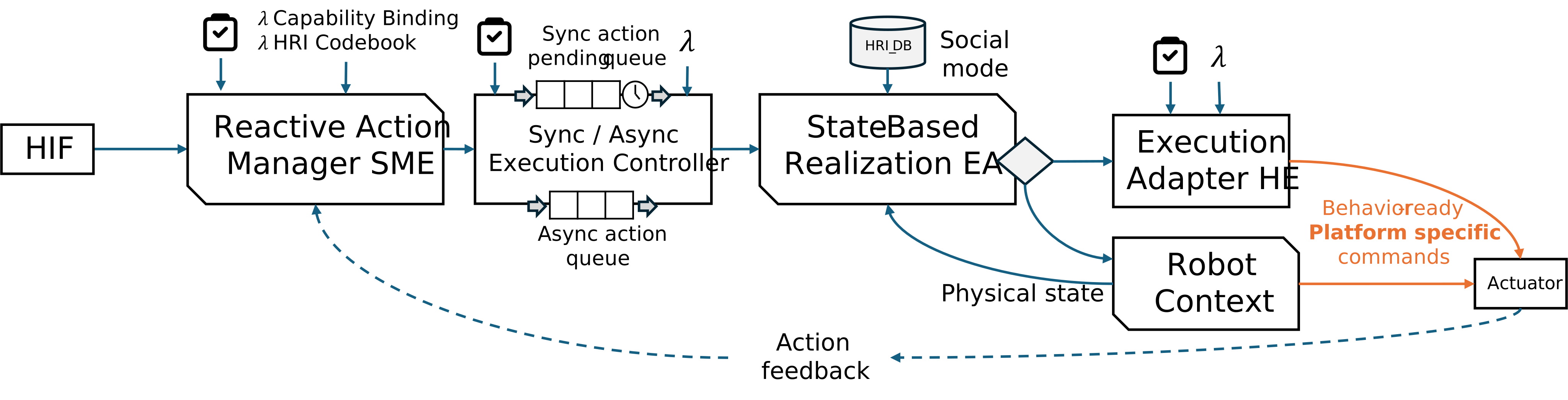
A simplified flow is:
Behavior-ready HIF
  → Reactive Action Manager SME
  → Sync / Async Execution Controller
  → State-Based Realization EAG
  → Policy Gate
      → Robot Context API
      → or Execution Adapter HE
  → platform-specific actuator commands
  → execution feedback
  → back to Reactive Action Manager
The diagram emphasizes that actuation is not a single API call.
It is a final semantic control layer that binds a requested behavior to a specific embodiment, current robot state, execution policy, and platform interface.
The Reactive Action Manager SME may use binding experts and codebook experts to adapt the requested action to the target platform and decompose it into executable primitives.
The Sync / Async Execution Controller manages whether actions must be performed sequentially or can be executed in parallel.
The State-Based Realization EAG performs a late, resource-aware and state-aware adjustment before execution.
Finally, the Policy Gate decides whether the action should be routed through Robot Context as an internal robot capability API, or directly through an Execution Adapter HE that translates the action into platform-specific commands.
The exact structure may vary by robot platform.
The important architectural point is that actuation remains semantic, traceable, state-aware, and feedback-aware.
Reactive Action Manager SME
The Reactive Action Manager SME is the entry point of the Actuation Layer.
It receives behavior-ready HIFs and decides how they should be prepared for execution on the current platform.
It may handle both:
reactive / urgent actions
and:
primitive actions decomposed from interactive or proactive behaviors
For example:
stop
avoid obstacle
turn toward speaker
cancel unsafe motion
pause speech
lower volume
perform greeting gesture
execute styled speech
execute social navigation step
The manager is modeled as an SME because a single requested action may require several experts before it can be executed.
Possible experts include:
λ capability binding expert
λ HRI codebook expert
λ speech binding expert
λ motion binding expert
λ gesture binding expert
λ platform compatibility expert
λ fallback selection expert
For example:
wave_hello
  → codebook expert
  → embodiment-specific primitive sequence

say politely
  → speech binding expert
  → TTS parameters

approach socially
  → motion binding expert
  → social navigation parameters
This keeps the actuation entry point modular and platform-aware.
Reactive actions may bypass Social Planning when latency matters, but they should not bypass semantic actuation control.
Reactive actions may bypass social planning,
but they should not bypass semantic actuation control.
The manager also receives execution feedback.
This allows it to update local execution state, retry, select fallback behaviors, cancel pending primitives, or emit feedback HIFs to previous layers.
Capability Binding
Capability binding is primarily handled inside the Reactive Action Manager SME.
Given a behavior-ready HIF, the manager may call different binding experts or codebook experts in order to adapt the requested action to the target robot platform.
For example:
StyledSpeechHIF
  → speech binding expert
  → select TTS engine
  → bind language, voice, volume, tempo, and emotional tone
or:
StyledGestureHIF
  → codebook binding expert
  → select embodiment-specific gesture realization
  → decompose into primitive actions
or:
StyledMotionHIF
  → motion binding expert
  → select navigation or motion controller
  → bind speed, distance, path constraints, and safety margins
Possible capabilities include:
TTS engine
emotion-aware speech library
navigation stack
motion controller
gesture controller
animation player
screen expression library
LED / sound cue library
ROS action server
ROS topic publisher
ROS service client
vendor SDK
custom behavior API
Capability binding is therefore not merely technical dispatch.
It is an SME-level process that may use several experts to preserve the relationship between the social style selected by the previous layer and the platform-specific mechanism that can realize it.
HRI Codebook and Embodiment Mapping
The HRI Codebook can be implemented as one of the experts used by the Reactive Action Manager SME.
When the incoming HIF refers to a semantic gesture, expression, or social action, the manager can call the codebook expert to translate that semantic name into an embodiment-specific primitive sequence.
The HRI Codebook maps semantic social actions to embodiment-specific primitive sequences.
It separates:
social meaning
from:
embodied performance
For example, the semantic action:
wave_hello
may be realized differently on different robots.
Humanoid Example
{
  "gesture": "wave_hello",
  "embodiment": "humanoid",
  "sequence": [
    {"action": "raise_right_arm"},
    {"action": "wave_wrist", "repetitions": 2},
    {"action": "look_at_person"}
  ]
}
Quadruped Example
{
  "gesture": "wave_hello",
  "embodiment": "quadruped",
  "sequence": [
    {"action": "orient_body_to_person"},
    {"action": "small_bow"},
    {"action": "play_friendly_sound"}
  ]
}
Desktop Robot Example
{
  "gesture": "wave_hello",
  "embodiment": "desktop_robot",
  "sequence": [
    {"action": "screen_eye_smile"},
    {"action": "small_head_tilt"},
    {"action": "friendly_led_animation"}
  ]
}
The same social behavior name can therefore remain stable across systems, while its embodiment-specific realization changes.
The codebook may contain entries such as:
wave_hello
show_happiness
show_uncertainty
ask_attention
apologize
acknowledge
invite_follow
show_thinking
warn_gently
Each entry may define:
supported embodiment
primitive sequence
timing
parameters
fallback behavior
preconditions
expected feedback
The codebook also allows social behaviors to be authored by embodiment experts, animators, or robot developers, while remaining accessible through semantic HIF names.
This is especially important in HRI because natural-looking expression often requires design skill, not only engineering correctness.
Sync / Async Execution Controller
The Sync / Async Execution Controller decides how prepared primitive actions should be scheduled.
Some actions must be performed in a strict sequence.
Other actions can run in parallel in order to produce more natural behavior.
The controller therefore manages two execution structures:
Pending queue:
  actions that must wait for ordering, completion, or synchronization

Async buffer:
  actions that may run concurrently with other channels
The controller continuously releases the actions that should be executed now, according to policy, timing constraints, dependencies, and feedback.
Synchronous Execution
Some behaviors require strict order.
For example:
raise arm
then wave
then lower arm
or:
navigate to person
then stop
then speak
In these cases, the system must wait for completion events before starting the next primitive.
This requires:
sequence control
completion feedback
timeouts
failure handling
cancel / retry logic
Asynchronous Execution
Other behaviors are more natural when multiple channels run together.
For example:
turn toward person while speaking
move slowly while explaining
gesture while saying hello
look at person before and during speech
In HRI, it is often more natural to:
speak + move
than to:
move
then speak
then move
However, asynchronous execution still requires coordination.
For example:
speech should start after gaze lock
gesture should peak near a key word
motion should slow before entering personal space
TTS should not overlap an emergency warning
a gesture should not conflict with navigation stability
The controller therefore needs a synchronization model that can express:
start together
start after
wait until
interrupt
cancel
pause
resume
sync point
timeout
This controller is the final synchronization mechanism that turns multimodal HIFs into coordinated embodied behavior.
State-Based Realization EAG
The State-Based Realization EAG performs the final state-aware adaptation before execution.
It is modeled as an EAG because the realization of the same semantic action may change according to robot state, social state, resource state, and execution policy.
same semantic action
  → different realization depending on state
The EAG may use:
Robot Context:
  battery
  CPU / memory
  actuator availability
  current posture
  autonomy level
  sensor health
  resource constraints

HRI_DB:
  social mood
  affective state computed upstream
  person-specific preferences
  interaction history
  social context
  recent failures or repeated requests
For example:
wave_hello + normal state:
  normal wave

wave_hello + low battery:
  smaller gesture or screen cue

wave_hello + happy social mood:
  larger, more energetic gesture

wave_hello + formal context:
  minimal gesture
Or:
ask_help + repeated failure:
  more apologetic phrasing
  reduced motion intensity
  lower interruption level
This resembles a state-pattern realization, but with explicit HML semantics.
The state does not have to originate in the Actuation Layer.
It may be computed by Robot Context, SIAH, DSIE, Social Planning, or other upstream layers.
However, the Actuation Layer may also maintain execution-local state, such as:
gesture intensity slowly decays
frustration-like state cools down over time
energy level is reduced after repeated attempts
recent failure affects fallback choice
The output of the EAG is a nearly final platform-specific behavior representation.
It is still semantic, but now it is tuned to the current robot and social state.
Policy Gate: Robot Context API or Execution Adapter
After state-based realization, a policy gate decides how the action should be executed.
Some actions should be routed through Robot Context.
In this role, Robot Context acts as an internal API for robot capabilities.
For example:
update autonomy state
trigger internal robot behavior
request current actuator capability
execute a capability exposed by the robot context layer
Other actions may go directly to the Execution Adapter HE, which translates the behavior into a platform-specific command.
For example:
publish ROS topic
call ROS action
call SDK function
trigger TTS
run animation
send navigation goal
This split allows the system to distinguish between actions that should be mediated by the robot's maintained self-model and actions that can be sent directly to a concrete actuator interface.
In both cases, the output should be behavior-ready and platform-specific.
State-Based Realization EAG
  → Policy Gate
      → Robot Context API
      → Execution Adapter HE
  → platform-specific actuator command
Execution Adapter HE
The Execution Adapter HE converts state-tuned HIF-level actions into platform-specific actuator commands.
It is modeled as an HE because it is the final heuristic / execution bridge between semantic behavior and low-level platform interfaces.
Possible targets include:
ROS topic publish
ROS action call
ROS service call
SDK function call
TTS API call
animation player command
navigation goal
motion primitive
controller-specific message
For example:
StyledSpeechHIF
  → TTS API request

StyledMotionHIF
  → navigation action

CodebookGestureHIF
  → animation player command

ReactiveStopHIF
  → emergency stop controller
In a ROS-based system, the customer or platform developer may expose sensing and action interfaces as ROS topics, actions, or services.
The Actuation Layer can then bind HIFs to those interfaces.
But the design pattern is not ROS-specific.
The same layer can target:
ROS
robot vendor SDKs
cloud robotics APIs
local controller APIs
animation systems
virtual agent renderers
The abstraction is:
HIF-level behavior
  → platform-specific execution
The output of the Execution Adapter HE is no longer only a semantic behavior description.
It is a behavior-ready, platform-specific command.
StyledBehaviorHIF
  → state-based realization
  → execution adapter
  → platform-specific actuator command
Feedback Loop
Actuation should not be a one-way path.
Execution feedback returns first to the Reactive Action Manager SME.
The manager can then decide whether to:
mark the action as complete
retry
select a fallback
cancel pending primitives
update execution-local state
emit a feedback HIF to previous layers
From there, feedback may also flow back into Robot Context, Context Management, HRI_DB, DSIE, SIAH, TPR, or Social Planning.
The layer may emit:
ActionStartedHIF
ActionProgressHIF
ActionSucceededHIF
ActionFailedHIF
ActionInterruptedHIF
ActionTimeoutHIF
HumanResponseObservedHIF
Examples:
speech failed because the speaker was unavailable
navigation failed because the path became blocked
gesture failed because an actuator was unavailable
the human ignored the robot
the human smiled after the gesture
the task was partially completed
For example:
ActionFailedHIF
  → Reactive Action Manager SME
  → Robot Context updates capability state
  → CNE detects meaningful failure
  → SIAH lowers autonomy
  → TPR re-evaluates pending tasks
or:
HumanResponseObservedHIF
  → Reactive Action Manager SME
  → DSIE updates social insight
  → HRI_DB stores a preference
  → future SAS style selection changes
This closes the HRI loop.
The robot does not only act.
It observes how action unfolds and updates its maintained understanding.
Relationship to Previous Layers
| Layer | What it decides |
|---|---|
| Context Management and Reasoning | What is known, ready, acceptable, and valid |
| Social Planning and Behavioral Synthesis | When and how behavior should be expressed |
| Actuation Layer | How behavior is realized on this robot embodiment |
The Actuation Layer should preserve decisions made earlier.
For example:
If Social Planning selected low volume:
  the TTS binding should preserve low volume.

If SAS selected approach distance:
  the motion controller should respect that distance.

If SCV required non-intrusive behavior:
  the codebook should avoid expressive overacting.

If SIAH reduced autonomy:
  execution should avoid commands that exceed the new autonomy level.
The Actuation Layer is also allowed to use Robot Context as an execution-facing API.
This does not contradict the earlier role of Robot Context as a context-producing layer.
It means that the robot's maintained self-model can also expose controlled capability interfaces for execution.
In this sense, Robot Context participates in both directions:
bottom-up:
  sensing and internal state become Robot Context HIFs

top-down:
  selected actions may be routed through Robot Context APIs
Outputs
The Actuation Layer may emit several feedback and execution HIFs.
ExecutionCommandHIF
ActionStartedHIF
ActionProgressHIF
ActionSucceededHIF
ActionFailedHIF
ActionInterruptedHIF
ActionTimeoutHIF
ActionCancelledHIF
HumanResponseObservedHIF
CapabilityUnavailableHIF
FallbackExecutedHIF
Example:
{
  "type": "ActionSucceededHIF",
  "properties": {
    "action": "wave_hello",
    "embodiment": "desktop_robot",
    "realization": "screen_eye_smile + head_tilt + led_animation",
    "duration": "1.8s"
  },
  "processing_history": [
    "HRI_Codebook",
    "ExecutionAdapter"
  ]
}
Failure example:
{
  "type": "ActionFailedHIF",
  "properties": {
    "action": "speak",
    "reason": "speaker_unavailable",
    "fallback_available": true,
    "fallback": "screen_text"
  },
  "processing_history": [
    "CapabilityBinding",
    "ExecutionAdapter"
  ]
}
Why This Layer Matters
This layer is where the architecture finally meets the robot's body.
The Actuation Layer is where HRI becomes embodied.
A robot may compute the correct social behavior but still fail if the embodiment cannot express it naturally.
For example:
speech may sound too flat
gesture may look mechanical
movement may feel intrusive
timing may feel unnatural
the wrong library may ignore emotion or language constraints
the same gesture may not transfer across robot bodies
It also protects the architecture from assuming that a behavior has one universal realization.
The same HIF may be executed differently depending on embodiment, state, timing, resource availability, and social context.
This is why natural actuation requires more than API integration.
Natural actuation helps preserve social meaning across different embodiments.
It also supports platform portability.
A high-level behavior such as:
acknowledge politely
can remain stable, while its realization changes across:
humanoid robot
quadruped robot
desktop robot
mobile robot
virtual agent
voice-only assistant
This makes the final layer both technical and social.
SOCIAL Principles Supported
S — Separated Contexts
The Actuation Layer separates:
behavior meaning
style
embodiment mapping
state-based realization
execution command
execution feedback
This prevents high-level social behavior from being hard-coded directly into robot drivers.
O — Open Declarative
The HRI Codebook and execution mappings can be represented declaratively.
For example:
gesture = wave_hello
embodiment = humanoid
sequence = raise_arm → wave → look_at_person
This makes behavior realization inspectable and editable.
C — Clear Cognition
The system can explain how a behavior-ready HIF became a robot-specific command.
For example:
StyledBehaviorHIF requested a polite greeting.
The codebook selected the desktop-robot realization.
The state-based realization reduced gesture intensity due to low battery.
The execution adapter triggered screen smile, head tilt, and LED animation.
I — Interpretable Gates
Capability binding, reactive action management, synchronization control, state-based realization, policy routing, and execution adapters are explicit gates.
They can be inspected, replaced, logged, and tuned.
A — Adaptive Autonomy
The layer can adapt execution based on:
robot capability
battery level
autonomy state
affective state
available actuators
resource limitations
feedback
It can also choose fallback actions when the preferred modality is unavailable.
L — Layered Validation
Actuation is not the end of reasoning.
Execution feedback returns to previous layers.
Failures, interruptions, and human responses become new context for future decisions.
Tradeoffs
| Tradeoff | Explanation |
|---|---|
| Naturalness vs. portability | Highly natural behaviors may require robot-specific tuning |
| Expressiveness vs. embodiment limits | Some robots cannot express all social channels |
| Abstraction vs. control | HIF-level abstraction may hide low-level constraints |
| Reuse vs. robot-specific tuning | Codebooks increase reuse but still need per-robot authoring |
| Low latency vs. feedback monitoring | Fast actions may provide less detailed feedback |
| Synchrony vs. robustness | Tight multimodal synchronization can be fragile |
| State-based adaptation vs. predictability | State-dependent execution can make behavior less uniform |
| Direct execution vs. Robot Context mediation | Routing through Robot Context adds consistency but may add latency |
Failure Modes
| Failure Mode | Possible Mitigation |
|---|---|
| Gesture mapping looks unnatural | Use embodiment experts, animators, or user testing |
| Unsupported modality | Capability filtering and fallback mappings |
| Style lost in translation | Preserve style constraints through execution binding |
| Command succeeds mechanically but fails socially | Return human response feedback to DSIE / HRI_DB |
| Feedback missing | Require minimum feedback contract for actions |
| ROS / API mismatch | Use adapter validation and simulation tests |
| Latency breaks timing | Use synchronization constraints and timeouts |
| Unsafe fallback | Validate fallback through SIAH and policy |
| State-dependent behavior feels inconsistent | Bound state effects and log state-based choices |
| Reactive path bypasses logging | Require semantic actuation control even for reactive actions |
| Sync queue blocks urgent async behavior | Priority and interrupt policies |
| Async buffer creates conflicting actions | Channel-level resource locking and conflict checks |
Implementation Notes
A practical Actuation Layer should define:
supported HIF input types
reactive action manager policy
capability registry
robot embodiment profile
HRI codebook schema
sync / async execution model
pending queue policy
async buffer policy
state-based realization policy
policy gate routing rules
execution adapter interfaces
feedback HIF schema
fallback policy
latency budget
logging requirements
minimum safety feedback contract
relationship to Robot Context
relationship to HRI_DB
relationship to SIAH
relationship to Social Planning
A capability registry may include:
speech:
  supported languages
  voices
  emotion control
  volume control

motion:
  navigation
  base rotation
  arm movement
  gesture primitives

display:
  screen expressions
  lights
  icons
  text

sound:
  beeps
  earcons
  affective sounds

feedback:
  started
  progress
  success
  failure
  interruption
The synchronization controller should define:
which channels can run in parallel
which channels are mutually exclusive
which actions require completion before continuation
which actions can be interrupted
which feedback events release pending actions
The state-based realization module should define:
which states affect execution
how strongly each state can modify behavior
which states decay over time
which upstream layer owns each state
how local execution state is reset
Closing Note
Together, the layers described in this documentation provide a path from context to embodied action.
Human, Scene, and Robot Context
  → Context Management and Reasoning
  → Social Planning and Behavioral Synthesis
  → Natural Actuation and Embodiment Binding
The framework does not prescribe one robot architecture.
It provides a reusable pattern language for building inspectable HRI systems that can sense, reason, plan, style, act, and learn from feedback.