Social Planning and Behavioral Synthesis
Overview
The previous layer, Context Management and Reasoning, determines what is known, ready, and acceptable.
This layer determines when and how the robot should express that validated intent as behavior.
Context Management:
  what is known, ready, and acceptable

Social Planning and Behavioral Synthesis:
  when and how the robot should behave
The goal of this layer is not to create new facts.
The goal is to transform validated interaction requests into socially timed and socially styled behavior.
In short:
validated interaction request
  → social timing
  → social styling
  → socially fluent behavior HIF
This layer is where the robot begins to move from reasoning about context into expressing behavior within a social interaction.
From Valid Request to Social Behavior
A request may be valid, executable, and socially acceptable at the end of Context Management.
However, that still does not determine:
when to express it
how to express it
which modality to use
how direct or polite to be
how close to approach
how loud to speak
whether to wait for eye contact
whether to adapt to a person-specific preference
For example, the request:
say: "I need your help"
may already be valid.
But the robot still needs to decide:
Should I say it now?
Should I wait until the person looks at me?
Should I approach first?
Should I speak softly?
Should I use a short phrase?
Should I add a gesture?
Should I avoid interrupting?
This layer manages those decisions.
It turns a valid request into a socially fluent action.
Reactive vs. Socially Planned Actions
Not every action must pass through this layer.
Some actions are reactive, urgent, or safety-critical.
These may go directly from Context Management, Dispatcher, or integrity handlers toward actuation.
Examples include:
stop
avoid obstacle
emergency brake
lower autonomy
cancel unsafe motion
reduce speed
These actions often require low latency.
They may bypass social planning.
By contrast, interactive or proactive requests should usually pass through Social Planning and Behavioral Synthesis.
Examples include:
ask for help
say a message
approach a person
remind someone
offer assistance
ask a clarification question
proactively initiate interaction
guide a person
explain a delay
These actions require more than technical execution.
They require:
social timing
social style
multimodal expression
This is the main distinction:
Reactive actions:
  must happen quickly

Social interaction requests:
  must happen appropriately
Layer Overview Diagram
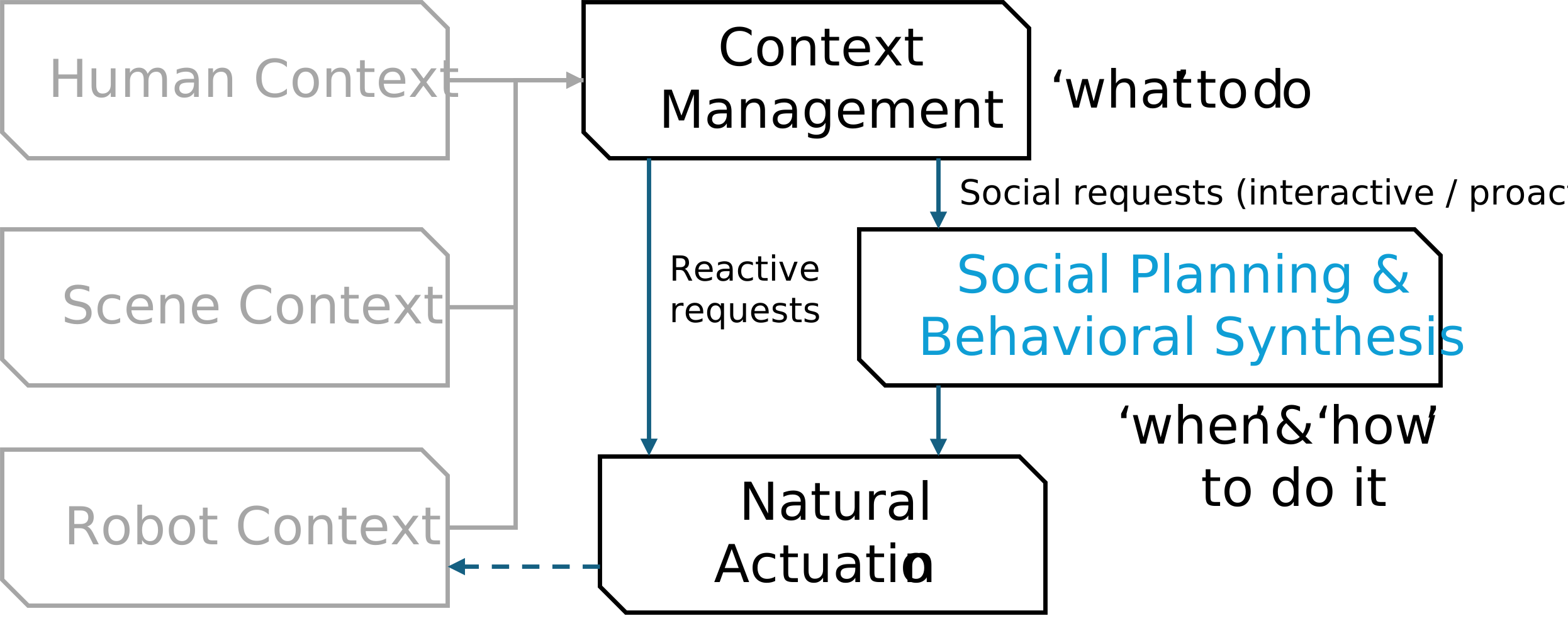
The diagram shows that Context Management may produce both reactive outputs and interaction requests.
Reactive outputs may go directly toward actuation.
Interaction requests enter Social Planning and Behavioral Synthesis, where they are timed and styled before reaching behavior execution.
The Two Main Questions
This layer is organized around two questions.
When should the robot interact?

How should the robot express the interaction?
The first question is handled by Social Opportunity TPR.
The second question is handled by Social Action Stylist (SAS).
Their composition forms the Late-Binding Behavioral Choreographer.
Social Opportunity TPR:
  decides when

Social Action Stylist:
  decides how

Late-Binding Behavioral Choreographer:
  binds when and how at the right moment
Social Opportunity TPR
Social Opportunity TPR is a specialized reuse of the Task Prerequisite Resolver pattern.
Instead of checking whether a task is missing an object, location, person, or capability, it checks whether the task is missing a social opportunity window.
The input is an interaction request HIF.
For example:
{
  "say": "I need your help"
}
The robot may be allowed to say this, but not necessarily now.
The Social Opportunity Gate ES checks whether the social window is open.
It may use experts such as:
λ person availability
λ person patterns
λ repeated help requests
λ gaze / attention estimator
λ interaction rhythm estimator
λ social context classifier
If the social window is open, the request can become:
Executable Socially Timed Request HIF
If the social window is closed, the request is held in a pending request queue.
The pending request handler can manage:
priority
decay factor
expiration
social window reopening
fact-triggered re-evaluation
This lets the robot wait for the right moment instead of interrupting at the first technically valid moment.
Social Action Stylist (SAS)
Social Action Stylist (SAS) is a specialized reuse of the SME structure.
It decides how a request should be expressed.
It can apply multiple stylist experts in parallel.
For example:
Linguistic Stylist ST
Spatial Stylist ST
Gesture Stylist ST
Gaze Stylist ST
Prosody / voice style ST
Interaction sequencing ST
The input may be a dry semantic intent:
say: "hello Bob"
The output may be socially styled content:
"Hey Bob! How are you today?"
with metadata such as:
tone
tempo
volume
politeness level
gesture choice
gaze behavior
approach distance
social path
For movement, the input may be:
move to waypoint
approach person
navigate near group
The output may be:
social path
personal-space-aware trajectory
proxemics-aware approach
SAS separates:
what the robot intends to do
from:
how the robot should express it socially
This makes social behavior modular, explainable, and adaptable.
Late-Binding Behavioral Choreographer
The Late-Binding Behavioral Choreographer connects the two previous patterns.
Social Opportunity TPR
  → decides when

Social Action Stylist
  → decides how
The reason for late binding is that social context changes quickly.
If the robot styles an action too early, the style may become outdated before the social opportunity opens.
For example:
the person may stop being angry
the person may become busy
the room may become formal
another person may join
the robot may move closer
the urgency may change
Therefore, behavioral synthesis should happen as late as possible.
The robot first waits for the right social window.
Then it applies the style using the most current context.
This avoids behavioral obsolescence:
a behavior that was appropriate when it was prepared,
but no longer appropriate when delivered
The choreographer therefore provides the social bridge:
socially acceptable and executable interaction request
  → socially timed request
  → socially styled behavior
Relationship to Context Management
Context Management answers questions such as:
What changed?
What is known?
What does the user mean?
Is the task executable?
Is the task socially acceptable?
Social Planning and Behavioral Synthesis answers:
When is the right moment?
How should this be expressed?
How should speech, movement, gesture, and timing be coordinated?
This distinction keeps reasoning and expression separate.
Context Management prepares the request.
Social Planning prepares the behavior.
Relationship to Actuation
This layer does not directly actuate motors, speakers, or robot hardware.
It produces behavior-ready HIFs.
These may later be sent to:
speech systems
gesture controllers
navigation systems
motion planners
facial expression systems
dialogue managers
robot-specific actuation bridges
The distinction is:
Social Planning:
  creates socially timed and styled behavior descriptions

Actuation:
  realizes those descriptions on a physical or virtual platform
This allows the same social planning structure to support different embodiments.
A mobile robot, humanoid, desktop robot, or virtual agent may all reuse the same high-level pattern, while implementing different actuation backends.
Patterns in This Section
This section contains the following pages.
Social Opportunity TPR
A TPR-based pattern for waiting until the right social window opens.
It answers:
When should the robot interact?
Social Action Stylist (SAS)
An SME-based pattern for applying social style to speech, movement, gesture, and interaction behavior.
It answers:
How should the robot express the interaction?
Late-Binding Behavioral Choreographer
A composition pattern that connects timing and styling.
It answers:
How do we bind the behavior style at the moment it is socially appropriate to act?
Social Planning Layer Example
A layer-level example showing how these patterns may connect into a complete social behavior synthesis pipeline.
Why This Layer Matters
This layer makes the difference between a robot that merely executes validated actions and a robot that behaves with social fluency.
A technically correct action can still be socially poor.
For example:
asking at the wrong time
speaking with the wrong tone
standing too close
interrupting too directly
using a phrase that is too formal or too casual
moving in a way that feels intrusive
Social Planning and Behavioral Synthesis reduces that gap.
It allows the robot to wait for the right moment and express the action in the right style.
The central principle is:
Do not bind behavior too early.
Wait for social opportunity.
Then style the behavior using the freshest context.
Transition to Social Opportunity TPR
The first pattern in this section is Social Opportunity TPR.
It specializes the prerequisite-resolution idea for social timing.
Instead of asking:
Do we have enough information to perform the task?
it asks:
Is the social window open for this interaction?
This is the robot's ability to wait for the right moment.