Task Prerequisite Resolver (TPR)
Intent
The Task Prerequisite Resolver (TPR) is an HRI design pattern for managing tasks or instructions that are not yet executable because some required information, context, timing, or capability condition is missing.
It allows the robot to hold an incomplete intention without prematurely failing the interaction.
In short:
Task / Instruction HIF
  → detect missing prerequisites
  → query context or HRI_DB
  → either produce an executable task
     or hold the task in a pending queue
The pattern is especially important in human-robot interaction because humans rarely provide complete, formal, machine-ready task specifications.
They often say things like:
Bring this bottle to Bob.
Put it over there.
Remind me when Alice arrives.
Tell him when he comes back.
Do it later.
These instructions may be understandable to another human because humans can infer missing context, wait for later facts, and ask clarifying questions.
TPR gives the robot a structured way to do the same.
Problem
Human instructions are often:
partial
ambiguous
context-dependent
time-dependent
dependent on information that is not yet available
dependent on the robot's current capability state
For example:
Bring this bottle to Bob.
This instruction may require several prerequisites:
Which bottle?
Where is the bottle?
Who is Bob?
Where is Bob?
Is Bob available?
Can the robot move now?
Is the path clear?
Is the instruction still relevant?
Without TPR, a robot may either:
fail with "I do not understand"
execute the wrong task
ask too many immediate clarification questions
ignore the instruction
attempt unsafe execution
TPR manages the logic of readiness.
It determines whether a task is sufficiently specified and contextually ready to be passed to planning or execution.
Context
Use TPR when the system receives tasks, goals, or instructions that may require additional information before execution.
Typical sources include:
language interpretation
user instruction handling
planner-generated subgoals
pending tasks from previous interactions
context-triggered tasks
socially motivated goals
TPR is useful when tasks may depend on:
missing people
missing object references
unknown locations
unresolved spatial references
future events
robot capability state
scene state
social context
timing constraints
HML Structure
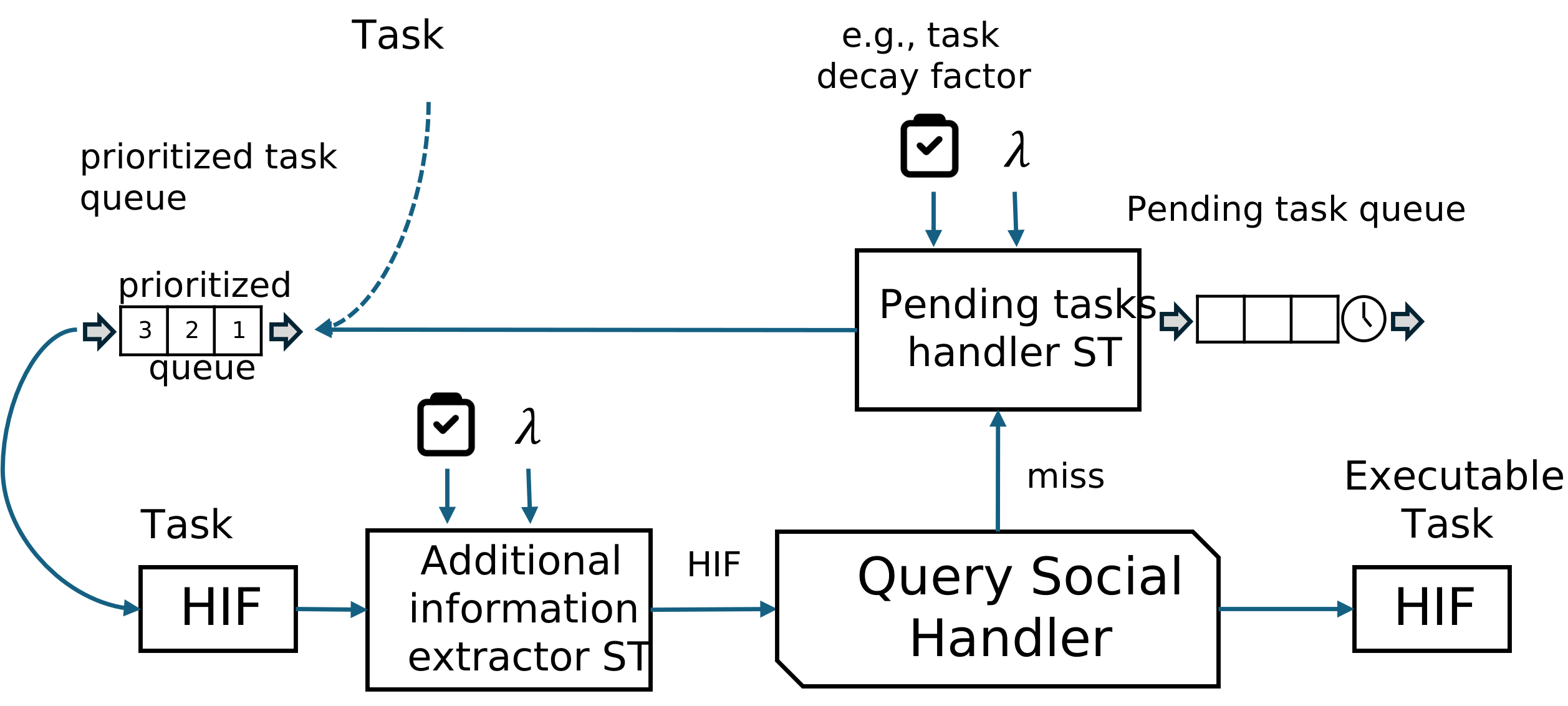
The abstract TPR pattern includes:
prioritized task queue
Task HIF
additional information extractor ST
Query Social Handler
pending task handler ST
pending task queue
Executable Task HIF
Flow
A typical TPR flow is:
1. A task or instruction enters as a HIF.
2. The task is placed in or compared against a prioritized task queue.
3. An Additional Information Extractor ST checks whether required fields are missing.
4. If information is missing, the pattern queries HRI_DB through QSH or related handlers.
5. If the missing information is found, the task is completed.
6. If the information is still missing, the task is moved to a pending task queue.
7. A pending task handler tracks task priority, decay, expiration, and re-evaluation.
8. New facts may reactivate pending tasks.
9. When all prerequisites are satisfied, TPR emits an Executable Task HIF.
This makes the pattern stateful.
It does not only check a task once.
It can keep the task alive until the missing prerequisites are resolved or the task becomes irrelevant.
Example — Instruction Handler TPR
A concrete use of TPR is instruction handling.
For example, the user may say:
Bring this bottle to Bob.
After language interpretation and spatial reference resolution, this may become an instruction HIF with a missing target location:
{
  "instruction": "pick_and_place",
  "item": {
    "ID": 5,
    "type": "bottle",
    "location": [10, 11, 3]
  },
  "target": {
    "ID": 8,
    "type": "Person",
    "name": "Bob",
    "location": "?"
  }
}
The item is known.
The target person is known.
But Bob's location is missing.
TPR detects the missing prerequisite:
target.location
It may then ask QSH:
Where is Bob?
If QSH returns a miss, the task cannot yet become executable.
TPR may produce a pending task and a clarification need.
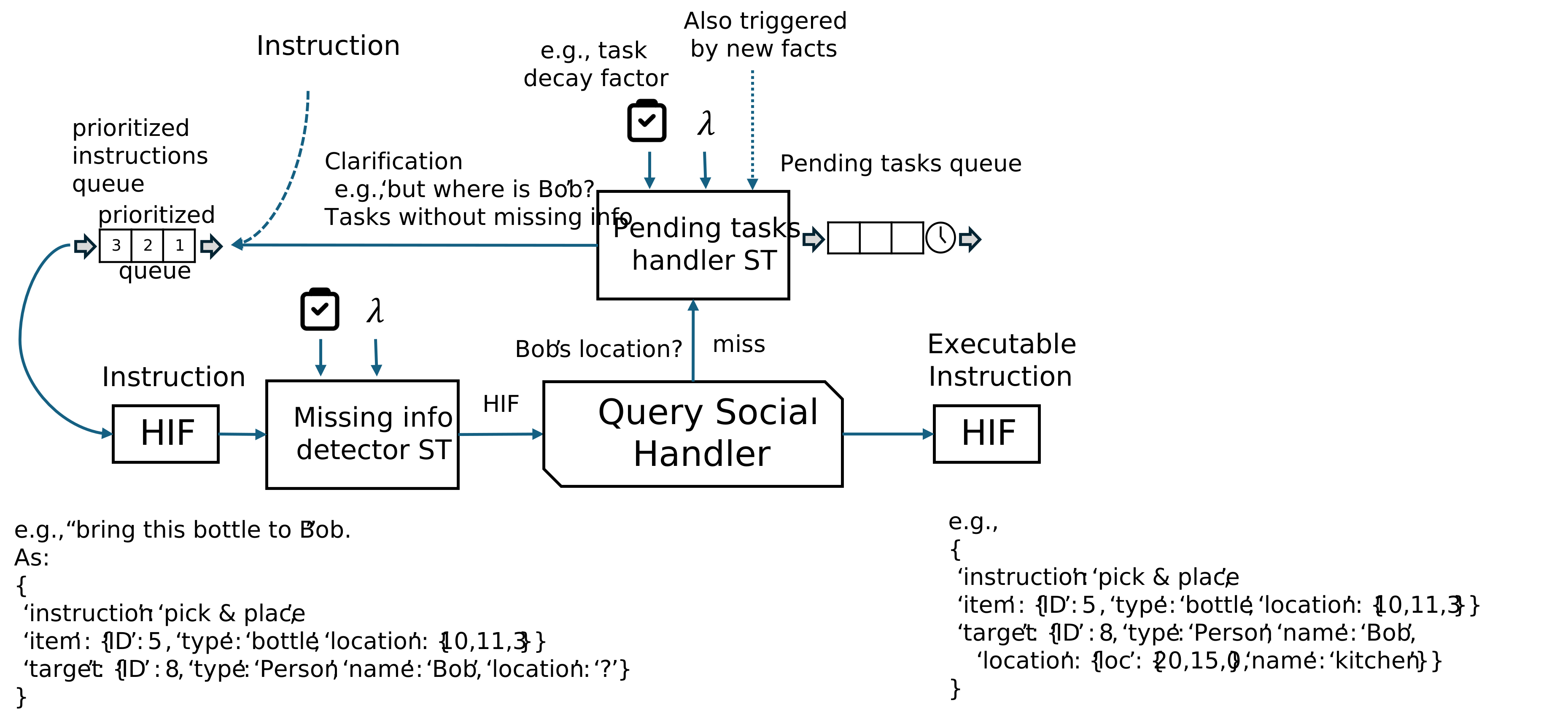
Fact-Triggered Resumption
One of the key features of TPR is fact-triggered resumption.
A task that cannot be executed now may become executable later.
For example, the task may wait because Bob's location is unknown.
Later, a new fact enters HRI_DB:
Bob is in the kitchen.
This new fact may trigger the pending task handler to re-evaluate waiting tasks.
The original task can now be completed:
{
  "instruction": "pick_and_place",
  "item": {
    "ID": 5,
    "type": "bottle",
    "location": [10, 11, 3]
  },
  "target": {
    "ID": 8,
    "type": "Person",
    "name": "Bob",
    "location": {
      "loc": [20, 15, 0],
      "name": "kitchen"
    }
  }
}
The output can now become:
Executable Instruction HIF
This is what makes TPR more than a simple missing-field checker.
It manages the lifecycle of incomplete tasks.
Clarification Is Not Immediate Speech
When TPR detects missing information, it should not necessarily force the robot to ask the user immediately.
Instead, it may emit a semantic HIF such as:
ClarificationNeededHIF
MissingPrerequisiteHIF
PendingTaskHIF
Later layers decide how to handle it.
For example, the system may decide to:
ask the user now
wait for a better moment
search HRI_DB first
ask another person
use SBR to resolve a spatial reference
let the task remain pending
cancel the task after timeout
ask in a socially softer way
This preserves the separation between reasoning and behavior.
TPR identifies readiness gaps.
It does not dictate the final interaction style.
Pending Task Queue
The pending task queue is the part of the pattern that prevents incomplete tasks from being lost.
It may store:
task HIF
missing prerequisites
priority
creation time
last evaluation time
decay factor
expiration policy
required facts
trigger conditions
source user
social sensitivity
The queue is prioritized.
It is also time-aware.
A task may become less relevant over time.
For example:
Bring Bob coffee.
If Bob leaves the building or the instruction is old, the task may no longer be appropriate.
The pending task handler may apply:
task decay factor
expiration policy
relevance checks
priority updates
fact-triggered re-evaluation
This prevents instruction bloat, where old incomplete tasks accumulate forever.
What TPR Can Resolve
TPR can manage several kinds of missing prerequisites.
Missing Entity Reference
"Bring this to Bob."
Missing:
this = ?
Bob = which person?
Possible handlers:
SBR
QSH
CEU
Missing Location
"Bring the bottle to Bob."
Missing:
Bob's location
bottle location
reachable path
Possible handlers:
QSH
SBR
Scene Context
Robot Context
Missing Timing Condition
"Remind me when Alice arrives."
Missing:
Alice has not arrived yet
TPR keeps the task pending until a new fact indicates that Alice arrived.
Missing Capability
"Go to the meeting room."
Missing or blocking condition:
motion unavailable
battery too low
localization uncertain
path blocked
Possible handlers:
Robot Context
SIAH
SCV
Missing Social Condition
"Interrupt the meeting and tell Bob I need him."
Missing or blocking condition:
is interruption socially appropriate?
is Bob available?
is the room formal?
Possible handlers:
DSIE
SCV
QSH
Relationship to Other Handlers
TPR is a bridge pattern.
It uses other Context Management handlers to resolve prerequisites.
Relationship to QSH
QSH answers contextual questions.
TPR uses QSH to complete missing task slots.
QSH:
  Where is Bob?

TPR:
  I need Bob's location before this instruction can become executable.
Relationship to SBR
SBR resolves spatial references.
TPR uses SBR when a missing prerequisite depends on spatial meaning.
"this bottle"
"that door"
"the object closest to Bob"
"the place over there"
Relationship to CEU
CEU checks whether new facts can update memory.
TPR may depend on CEU when a user gives a missing fact.
For example:
User:
  Bob is in the kitchen.

CEU:
  checks consistency and updates HRI_DB.

TPR:
  re-evaluates pending tasks involving Bob.
Relationship to SIAH
SIAH protects system integrity and autonomy.
TPR may use Robot Context or SIAH outputs to decide whether a task is currently executable.
For example:
motion system degraded
battery too low
speaker unavailable
localization uncertain
Relationship to SCV
TPR checks whether the task is ready.
SCV checks whether the task is socially appropriate.
A task may be fully specified but still socially invalid.
Outputs
TPR may emit several kinds of output HIFs.
ExecutableTaskHIF
ExecutableInstructionHIF
PendingTaskHIF
MissingPrerequisiteHIF
ClarificationNeededHIF
TaskExpiredHIF
TaskReactivatedHIF
TaskRejectedHIF
Example: Pending Task
{
  "type": "PendingTaskHIF",
  "properties": {
    "task": "bring_object_to_person",
    "item_id": "bottle_5",
    "target_person": "bob",
    "missing_prerequisites": [
      "target.location"
    ],
    "status": "waiting_for_information",
    "decay_factor": 0.8
  },
  "processing_history": [
    "TPR"
  ]
}
Example: Executable Task
{
  "type": "ExecutableTaskHIF",
  "properties": {
    "task": "bring_object_to_person",
    "item_id": "bottle_5",
    "item_location": [10, 11, 3],
    "target_person": "bob",
    "target_location": [20, 15, 0],
    "target_location_name": "kitchen"
  },
  "processing_history": [
    "TPR"
  ]
}
Example: Clarification Need
{
  "type": "ClarificationNeededHIF",
  "properties": {
    "task": "bring_object_to_person",
    "missing_prerequisite": "target.location",
    "suggested_question": "Where is Bob?"
  },
  "processing_history": [
    "TPR"
  ]
}
Why This Pattern Matters
TPR helps the robot move beyond command-response behavior.
Without TPR, the robot may fail whenever an instruction is incomplete.
With TPR, the robot can:
hold an incomplete intention
identify what is missing
search memory
ask for clarification when needed
wait for future facts
resume tasks when missing information arrives
expire old tasks
avoid executing under-specified instructions
This is essential for agentic autonomy.
The robot becomes able to manage its own information gaps.
SOCIAL Principles Supported
S — Separated Contexts
TPR separates:
task intent
missing information
query process
pending state
executable task output
This prevents incomplete instructions from being treated as executable commands.
O — Open Declarative
Pending and executable tasks are represented as explicit HIFs.
The missing fields are visible.
C — Clear Cognition
The system can explain why a task is pending:
Bob's location is missing.
The object reference is ambiguous.
The robot cannot move right now.
The task has expired.
I — Interpretable Gates
The Missing Information Extractor ST and Pending Tasks Handler ST are explicit gates.
They decide whether a task is ready, pending, expired, or in need of clarification.
A — Adaptive Autonomy
The robot can continue managing tasks over time instead of requiring complete commands upfront.
It can also reduce autonomy when prerequisites are not satisfied.
L — Layered Validation
TPR does not execute the task.
It produces a planning-ready task HIF that can still be checked by SCV, social planning, and actuation layers.
Tradeoffs
| Tradeoff | Explanation |
|---|---|
| Robustness vs. complexity | Holding incomplete tasks increases robustness but adds state management |
| Proactivity vs. annoyance | Clarification requests can help or interrupt |
| Persistence vs. stale tasks | Pending tasks must decay or expire |
| Autonomy vs. user control | The robot may resume a task later, so policies must govern when this is allowed |
| Completeness vs. speed | Waiting for complete information may delay execution |
| Generality vs. schema design | TPR needs task schemas with explicit prerequisites |
Failure Modes
| Failure Mode | Possible Mitigation |
|---|---|
| Pending queue grows forever | Decay factor, expiration policy, relevance checks |
| Robot asks too many clarifications | Batch questions, cooldowns, SCV before asking |
| Task becomes irrelevant | Freshness and relevance checks |
| Wrong missing slot detected | Schema validation and task templates |
| Incorrect prerequisite completion | Confidence thresholds and CEU checks |
| User gives contradictory clarification | Route to CEU |
| Missing information requires spatial reference | Route to SBR |
| Missing information requires user-facing query | Route to QSH |
| Task is complete but unsafe | Route to SIAH or SCV |
| Resumed task surprises user | Notify or reconfirm before execution |
Implementation Notes
A practical TPR implementation should define:
task schemas
mandatory prerequisites
optional prerequisites
missing-field detection logic
task priority policy
task decay factor
expiration policy
pending queue structure
fact-triggered re-evaluation rules
clarification generation policy
relationship to HRI_DB
relationship to QSH / SBR / CEU
conditions for executable output
conditions for rejection
Each task type should define what must be known before it becomes executable.
For example:
bring_object_to_person:
  required:
    object_id
    object_location
    target_person_id
    target_location
    motion_available

  optional:
    preferred_delivery_style
    social_context
    urgency
Relationship to Planning
TPR is not a full planner.
It does not decide the complete action sequence.
Instead, it determines whether a task is ready for planning.
TPR output:
  executable task HIF

Planner output:
  selected action plan / behavior sequence / execution strategy
This keeps task readiness separate from behavior synthesis.
Transition to SCV
TPR determines whether a task is sufficiently specified and contextually ready.
The next pattern, Social Convention Validator (SCV), determines whether performing that task is socially appropriate.
TPR:
  Can this task be planned?

SCV:
  Should this task be performed in this social context?
Together, TPR and SCV form the bridge from Context Management and Reasoning into Social Planning and Behavioral Synthesis.