Context Management Layer Example
Overview
This page shows one possible composition of the Context Management and Reasoning layer.
It does not introduce a new pattern.
Instead, it connects the patterns introduced in this section into a working layer-level example.
The composition illustrates how the architecture may transform context streams into:
memory updates
query answers
resolved references
social insights
integrity decisions
executable instructions
socially validated instructions
primitive action HIFs
dispatcher inputs
This is an example, not a mandatory blueprint.
Different systems may connect the same patterns differently depending on domain, robot embodiment, safety policy, available sensors, and interaction goals.
The important idea is the architectural flow:
context streams
  → novelty extraction
  → memory and reasoning handlers
  → task prerequisite resolution
  → social validation
  → hierarchical task resolution
  → primitive action dispatch
This layer acts as a semantic buffer between understanding and action.
Layer Composition Diagram
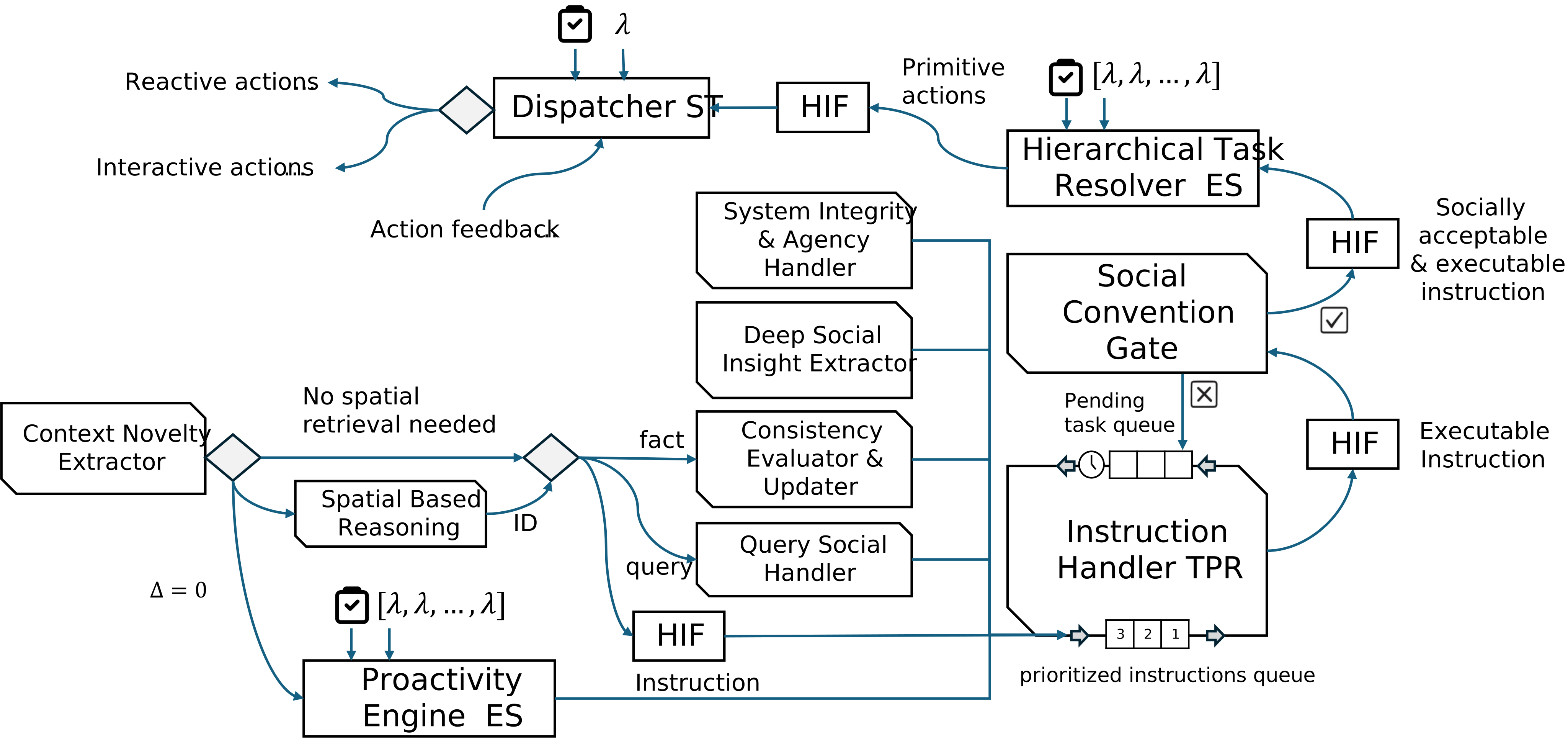
From Context Streams to Novelty
The layer begins with the Context Novelty Extractor (CNE).
The CNE receives unified context evidence derived from:
Human Context
Scene Context
Robot Context
It decides whether something meaningful has changed.
For example:
a person pointed at an object
a door changed state
a new instruction was spoken
a task became stuck
the robot's autonomy state changed
a person remained waiting for too long
If a meaningful delta exists, the output can continue into reasoning handlers.
If:
Δ = 0
the lack of change may still be meaningful.
For example:
the user is still waiting
the task has not progressed
the expected response did not arrive
the robot has not received new information
In that case, a Proactivity Engine ES may be triggered according to policy.
No novelty is not automatically a problem.
But persistent no-change can become a meaningful interaction signal.
Spatial Retrieval When Needed
Not every context update requires spatial reasoning.
The first routing decision asks whether spatial retrieval is needed.
If the context includes expressions such as:
this
that
over there
the closest bottle
the object I am pointing at
the person behind Bob
the system may route the HIF to Spatial-Based Reasoning (SBR).
SBR can resolve a spatial reference into an explicit ID.
For example:
"this bottle"
  → bottle_3
or:
"the bottle closest to Bob"
  → bottle_5
Once the ID is resolved, the downstream handlers can operate on a concrete semantic object instead of an ambiguous reference.
If spatial retrieval is not needed, the HIF can continue directly to the next routing decision.
Fact, Query, and Instruction Routing
After optional spatial resolution, the system identifies the kind of HIF being handled.
A context event may be a:
fact
query
instruction
Each type requires a different reasoning path.
Facts
Facts are routed to Consistency Evaluator and Updater (CEU).
For example:
Bob is in the kitchen.
This bottle is empty.
The meeting room door is closed.
Alice prefers short answers.
CEU checks whether the fact is consistent with HRI_DB and then decides whether to:
update memory
merge with existing memory
mark uncertainty
request clarification
reject the update
Queries
Queries are routed to Query Social Handler (QSH).
For example:
Where is Bob?
Is this bottle empty?
Do you know what I asked you to remember?
Can you do this now?
QSH uses short-term memory, session context, and HRI_DB to produce an answer or a clarification HIF.
Instructions
Instructions are routed toward Instruction Handler TPR.
For example:
Bring this bottle to Bob.
Tell Alice I am waiting.
Remind me when Bob arrives.
Go to the meeting room.
The instruction may be incomplete even after language interpretation.
TPR determines whether it is ready for planning or should remain pending.
Background Reasoning
Some handlers do not wait for a direct query or instruction.
They may run in the background and continuously update the system's maintained understanding.
Deep Social Insight Extractor
The Deep Social Insight Extractor (DSIE) can periodically query HRI_DB and update it with deeper social insights.
For example:
the person may be unavailable
the user may be frustrated
the setting has become formal
a preferred interaction style was reinforced
a social pattern is emerging
If an insight requires attention or action, DSIE emits a HIF.
Otherwise, it may simply update HRI_DB.
System Integrity and Agency Handler
The System Integrity and Agency Handler (SIAH) monitors internal robot state, integrity, and autonomy constraints.
It may use:
battery
CPU / memory / disk
sensor health
localization confidence
actuator state
anomaly detectors
diagnostic experts
prognostic experts
autonomy adjusters
SIAH may update HRI_DB with integrity state, lower the robot's autonomy level, or emit high-priority HIFs.
For example:
EmergencyStopHIF
AutonomyReductionHIF
IntegrityWarningHIF
SensorFailureHIF
This allows the layer to include not only social reasoning, but also system-level integrity and agency control.
Instruction Handler TPR
The Instruction Handler TPR manages instructions that may not yet be executable.
It receives an instruction HIF and checks whether required prerequisites are available.
For example, the instruction:
Bring this bottle to Bob.
may require:
object ID
object location
target person ID
target person location
motion availability
route availability
social permission to approach
If required information is missing, the instruction can be placed into a pending task queue.
The pending queue may track:
priority
missing prerequisites
task age
decay factor
expiration condition
re-evaluation triggers
When new facts enter HRI_DB, pending tasks may be re-evaluated.
This supports fact-triggered resumption.
For example:
pending task:
  Bring bottle_3 to Bob.
  Missing: Bob's location.

new fact:
  Bob is in the kitchen.

TPR:
  re-evaluates the task.
  emits ExecutableInstructionHIF.
This lets the robot hold incomplete intentions without failing the interaction.
Social Convention Gate
An instruction that becomes executable is not automatically ready for behavior.
It must still pass through a social validation step.
In the diagram, this appears as the Social Convention Gate.
This gate corresponds to the Social Convention Validator (SCV) pattern.
It asks:
Is this instruction socially acceptable now?
For example:
Is it appropriate to approach Bob?
Is Bob available?
Is this a formal room?
Should the robot speak quietly?
Should the robot ask permission first?
Is this action urgent enough to interrupt?
Does the robot's current autonomy state allow this?
If the instruction is not socially acceptable, it may be:
modified
delayed
returned to the pending queue
rejected
escalated
If it is acceptable, the gate emits a:
Socially acceptable and executable instruction HIF
This is the bridge from context readiness to socially valid planning.
Hierarchical Task Resolver ES
The Hierarchical Task Resolver ES is the main addition in this layer-level composition.
It receives a socially acceptable and executable instruction HIF.
It then selects the appropriate task-handling expert.
For example:
bring_object_to_person
  → pick-and-place handler

say_message_to_person
  → speech interaction handler

guide_person_to_room
  → navigation and interaction handler

warn_about_obstacle
  → safety communication handler

approach_person
  → social approach handler
The selected expert decomposes the instruction into lower-level Primitive Action HIFs.
For example:
turn toward person
navigate to object
pick object
navigate to Bob
wait for availability
speak softly
hand over object
confirm completion
The Hierarchical Task Resolver does not replace the planning layer.
It prepares the right level of action representation for the next stage.
It translates a socially validated instruction into structured primitive actions that can be dispatched, planned, or choreographed.
Dispatcher ST
The Dispatcher ST receives primitive action HIFs and routes them toward the next execution-oriented systems.
The diagram shows possible outputs such as:
Reactive actions
Interactive actions
Action feedback
Reactive actions may include low-latency responses such as:
stop
avoid
turn
slow down
cancel unsafe motion
Interactive actions may include:
speech
gesture
approach
explanation
confirmation
clarification
social feedback
The Dispatcher is a boundary object.
It connects Context Management and Reasoning to later behavioral synthesis and actuation layers.
Action Feedback
Action feedback can return into the dispatcher and later become new context.
For example:
action succeeded
action failed
human reacted positively
human ignored the robot
actuator unavailable
task partially completed
social response was awkward
This feedback may later enter the context stream, trigger CNE, update HRI_DB, or influence DSIE and SIAH.
This closes the loop between action and context.
The robot does not only act.
It observes the consequences of action and updates its maintained understanding.
Layer Outputs
This example layer may produce several kinds of outputs.
ContextUpdateHIF
QueryAnswerHIF
ClarificationRequestHIF
SocialInsightHIF
IntegrityDecisionHIF
EmergencyActionHIF
ExecutableInstructionHIF
SociallyAcceptableInstructionHIF
PrimitiveActionHIF
ActionFeedbackHIF
Some outputs update memory.
Some are returned to the user-facing interaction loop.
Some prepare planning.
Some prepare actuation.
Some return as feedback into context.
Why This Composition Matters
This composition shows how the architecture avoids a direct jump from perception to action.
Instead of:
context
  → action
the layer creates an explicit reasoning path:
context
  → novelty
  → memory
  → reasoning
  → prerequisite resolution
  → social validation
  → hierarchical task resolution
  → dispatch
This prevents the robot from acting only because something was detected or requested.
Instead, the robot acts after the context was:
updated
queried
completed
validated
translated into the right level of action
This is the main role of the Context Management and Reasoning layer.
It turns context into planning-ready, socially valid, and traceable action candidates.
Design Note
The diagram is one possible composition.
A real implementation may:
split handlers across services
merge CEU and QSH in a small system
run DSIE and SIAH at different frequencies
send primitive actions directly to a planner
add more specialized task handlers
add more social validation gates
use a different dispatcher architecture
The important point is not the exact wiring.
The important point is that each step remains explicit:
what changed
what was stored
what was queried
what was completed
what was validated
what was decomposed
what was dispatched
This supports transparency, debugging, adaptation, and safer human-robot interaction.
Transition to Social Planning and Behavioral Synthesis
At the end of this layer, the system has planning-ready, socially validated, and context-grounded action candidates.
The next layer decides how these candidates should be expressed as behavior.
Context Management:
  what is known, ready, and acceptable

Social Planning and Behavioral Synthesis:
  how the robot should behave
The next section moves from context reasoning into social behavior generation.